
In this guide
- The work between disagreement and a decision
- Separate the person from the proposition
- Build an agenda that can carry the real issue
- Make equal participation a practical question
- Look at a child's week before an adult's preference
- Put financial questions in an intelligible order
- Allow disagreement to become more specific
- Notice when the process itself needs attention
- Use a proposal as something to examine
- Keep the interval between meetings purposeful
- Recognise the professionals around the conversation
- Judge the next step by what it will resolve
- Translate a principle into a daily arrangement
- Create room for a different understanding
- Keep responsibility visible after a discussion
- Questions that reveal how the approach works
01 / About
The work between disagreement and a decision
Family Mediator offers a structure for discussing family arrangements when a private conversation no longer provides enough room to think. The task may sound simple: identify the issue, hear different views and consider possible arrangements. In practice, these steps often become tangled. One person wants to talk about next week; another needs an explanation for something that happened months ago. Mediation gives those competing concerns an organised place in the discussion without assuming that they will all have the same answer.
Our approach begins with a distinction between managing a conversation and owning its outcome. A mediator can help define an agenda, draw attention to missing information and ask whether a proposal would work in ordinary life. The people taking part remain responsible for their own decisions. They can question an option, seek advice or decide that they are not ready to accept it. Participation should never depend on pretending that a difficult choice is easy.
This website describes the approach rather than a guaranteed experience or result. What can be offered in a particular situation depends on assessment, the issues involved and the arrangements agreed with the participants. A first enquiry is a chance to establish those details. It is also an opportunity to ask about the limits of the service before sharing a detailed family history or making plans around a meeting.
02 / About
Separate the person from the proposition
A proposed arrangement can be examined without treating its author as the problem. That matters when people will continue to have responsibilities towards each other, especially as parents. Instead of asking which person has presented the stronger argument, a useful discussion asks what an arrangement would require, what concern it answers and where it might create a new difficulty. This changes the work from defending positions to examining consequences.
For example, a disagreement about a collection time may involve working hours, travel, a child's evening routine and worries about reliability. Repeating the preferred time will not necessarily reveal these different concerns. A mediator can invite each person to explain the practical reason behind their preference and help keep the explanation distinct from an accusation. A proposal can then be adjusted against information rather than against assumptions about motives.
This does not mean that hurtful conduct is dismissed or that every difference is merely a misunderstanding. Some experiences affect whether participation is appropriate at all. Impartiality does not require ignoring intimidation, treating unequal circumstances as identical or asking someone to negotiate under pressure. The way a discussion is organised must be considered alongside the substance of the disagreement, with room to raise concerns privately.
03 / About
Build an agenda that can carry the real issue
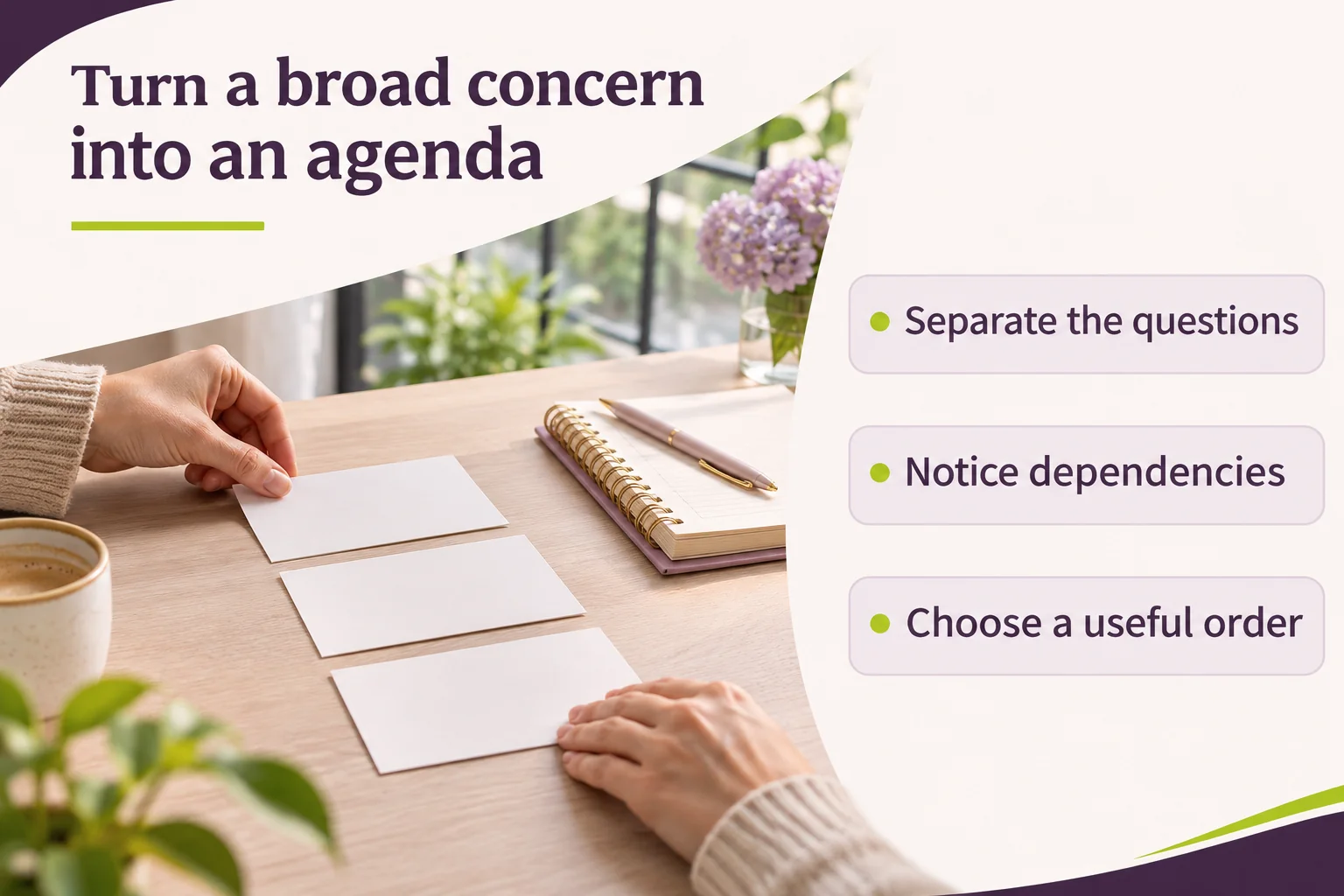
An agenda is useful when it describes decisions clearly enough for people to prepare. A heading such as communication may hide several separate questions:
- How routine messages are sent
- What counts as urgent
- Whether children carry information
- How changes are proposed
Naming these questions makes the work more concrete. It also allows people to notice whether they are talking about the same problem before they start comparing solutions.
There is no need for every concern to fit into one meeting. Some questions depend on answers that are not yet available. Others may require independent advice or a private assessment before they can be considered together. A realistic agenda identifies these dependencies instead of suggesting that every subject should be settled in a single conversation. Priorities can be revisited as new information becomes available.
Participants may have different views about what should come first. One may need a workable short-term routine; another may want to understand the financial picture. Rather than treating that difference as resistance, the discussion can identify what each person needs to make progress. A temporary practical question can be distinguished from a longer-term decision, with clear wording about what remains open and when it might be reconsidered.
04 / About
Make equal participation a practical question
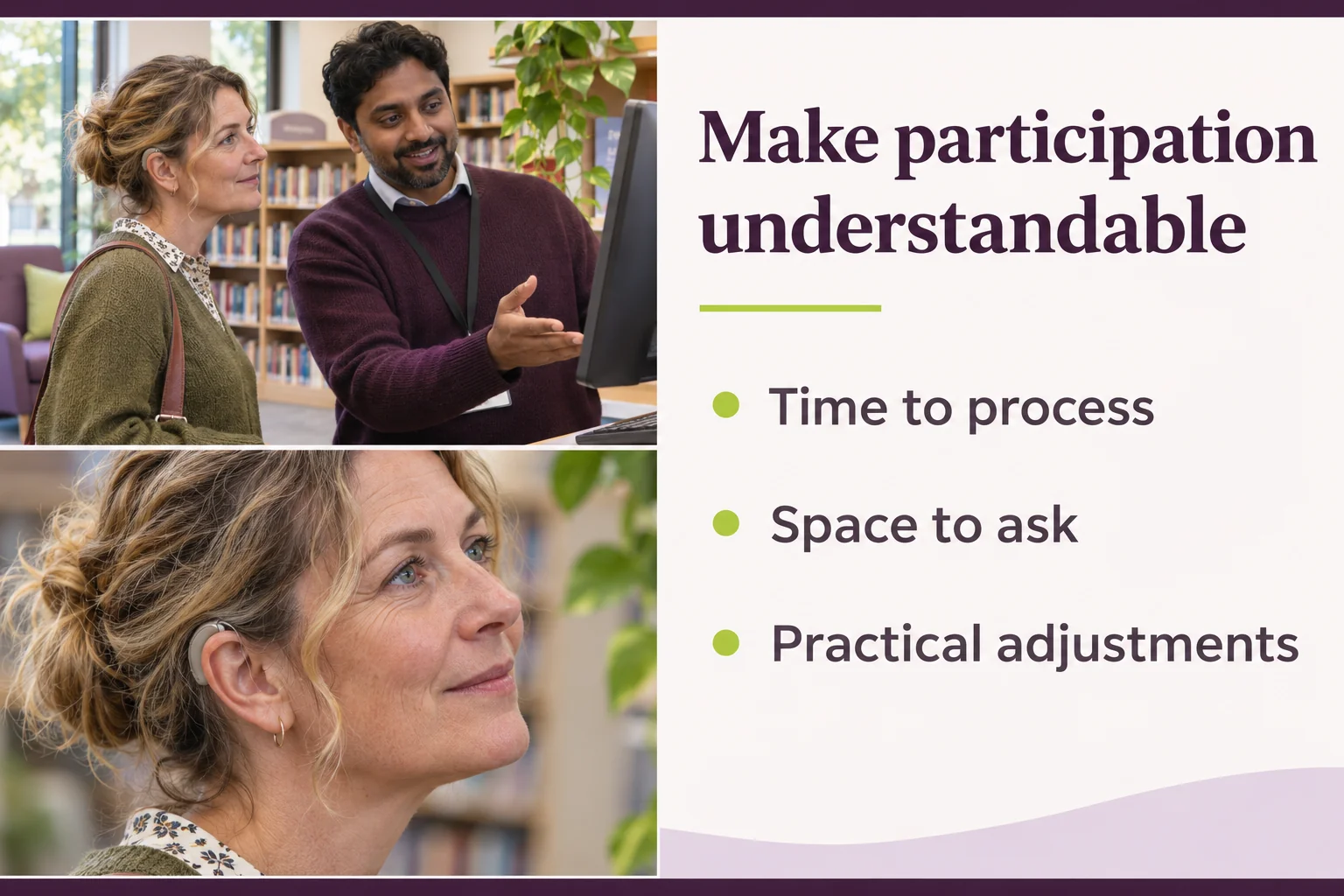
An invitation to speak is only part of being able to participate. People differ in how quickly they process information, how comfortable they feel interrupting and how readily they can ask for clarification. Some need time to read a document; others find it easier to explain an issue aloud. These differences deserve attention because they influence whether a discussion reflects informed choices or simply the confidence of the quickest speaker.
Useful adjustments might involve:
- A clearer agenda
- Planned breaks
- A slower explanation
- A different way of considering written information
Availability and suitability of any adjustment need to be discussed directly. A particular meeting format cannot be promised from a general website description, and a person should not have to disclose more sensitive detail than is needed to explain an access requirement during an initial enquiry.
Participation also involves recognising when understanding has not yet been reached. Asking someone to describe a proposal in their own words can reveal that two people have taken different meanings from the same sentence. That is a reason to clarify the wording, not to hurry towards agreement. Where a decision has financial or legal consequences, understanding the conversation must be accompanied by appropriate independent advice.
05 / About
Look at a child's week before an adult's preference
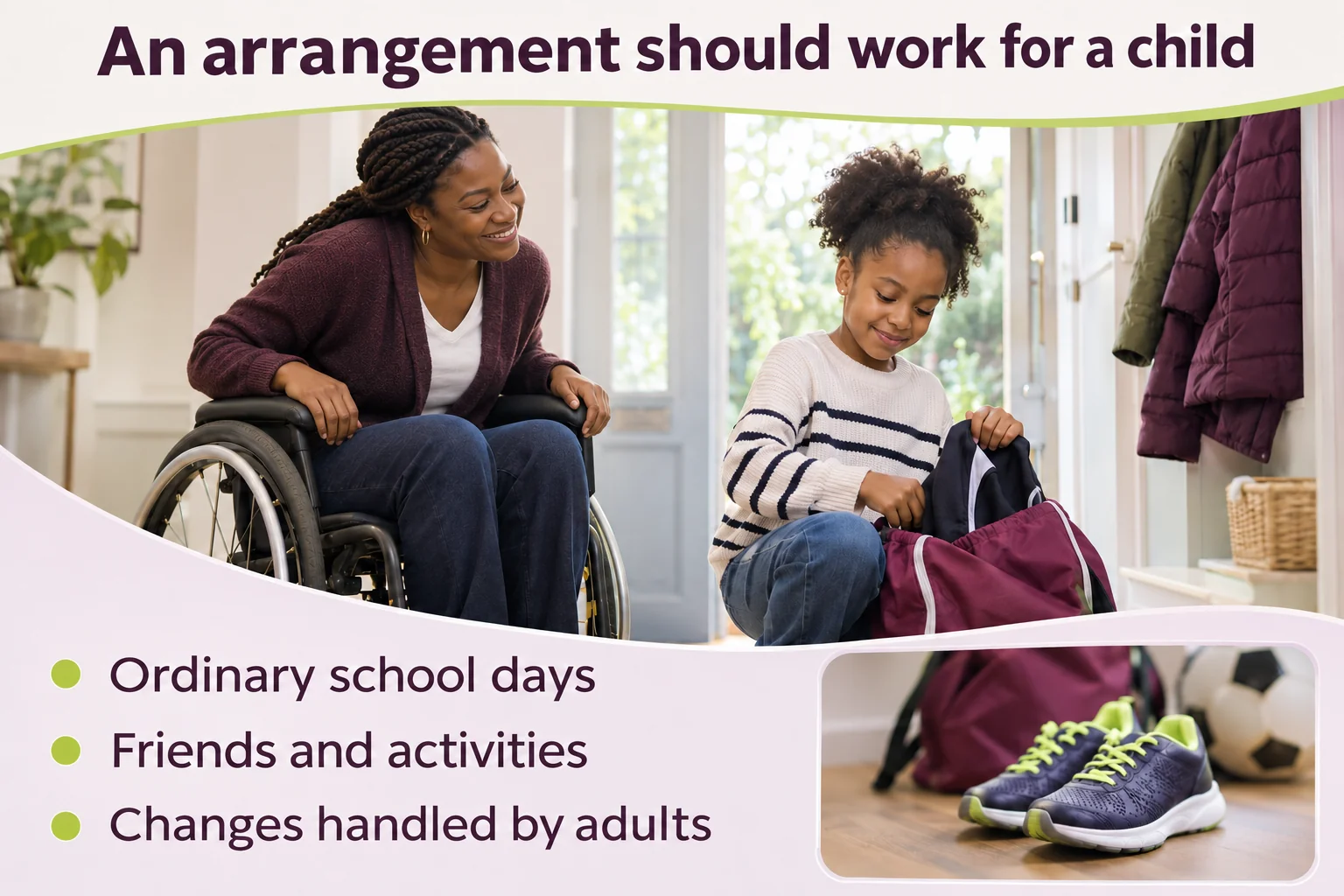
Children experience arrangements through ordinary events: getting ready, travelling between places, remembering school equipment, seeing friends and knowing who will collect them. Discussions about parenting become more useful when these details are made visible. An apparently balanced timetable can still create an exhausting school week. A convenient handover for an adult may put a child in the middle of a tense exchange.
A child-focused discussion can consider different ages, routines, additional needs and relationships without asking a child to settle an adult disagreement. The adults retain responsibility for the decisions they are making. They can explore what information they need, how to avoid using children as messengers and how to communicate an arrangement in terms a child can understand. Direct involvement of children is a separate professional question and is not promised by this website.
The practical test continues beyond the first timetable.
- What happens during school holidays?
- Who keeps track of a club that changes its meeting day?
- How is illness handled?
Thinking about exceptions helps distinguish a plan that looks tidy on paper from one that can support daily life. It can also reveal where a clear process for making changes matters more than writing an answer for every possible event.
06 / About
Put financial questions in an intelligible order
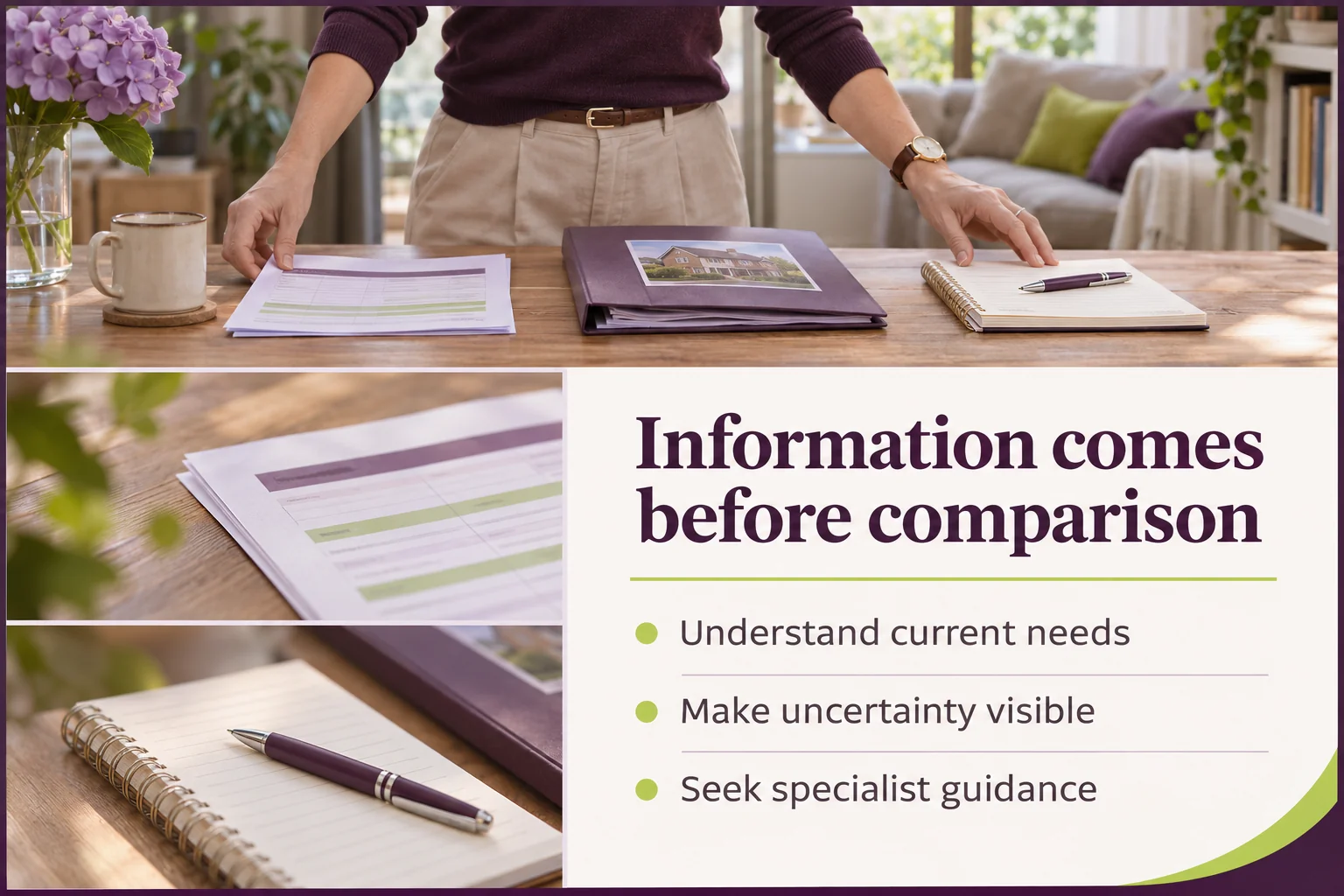
Money discussions often become difficult because different tasks are attempted at the same time. These are separate activities:
- Gathering information
- Understanding current needs
- Comparing future options
- Making a final decision
A structured discussion can keep them in a sensible order. A person may be able to explain a current expense without being ready to decide how a longer-term resource should be treated.
Practical preparation can include identifying categories of information and questions that need specialist input. It does not require guessing figures to fill gaps or assuming that the other person has access to the same records. Where information is incomplete, the gap should remain visible. Comparing options against uncertain figures may create confidence that the underlying information does not justify.
A mediator's role differs from that of an independent legal, financial, tax or pension adviser. Participants may need advice about entitlements, implications and the legal effect of any proposed arrangement. Mediation does not replace that advice or guarantee that a proposal will be accepted by a court. Before making commitments, each person should understand which issues have been discussed, what remains provisional and what further professional work may be required.
07 / About
Allow disagreement to become more specific
Progress does not always mean finding a shared answer immediately. Sometimes it means identifying exactly where two views differ. People may agree on the facts but disagree about priorities; they may share a priority but rely on different information. These are different kinds of difficulty. Making the difference explicit can help the participants decide what would be useful next rather than repeating the entire argument.
Specific disagreement also makes it easier to recognise partial understanding. If two people agree about a school routine but not a holiday proposal, the unresolved holiday issue need not erase the work already done. Equally, agreement on one topic should not be used to pressure someone into accepting another. The scope of any understanding needs to be clear, including whether different elements depend on each other.
Some discussions will reveal that mediation cannot provide a useful route at that point. That possibility belongs within an honest description of the process. A pause, further information or another form of assistance may be needed. The service should be considered on the quality and suitability of the process rather than on an expectation that every enquiry must turn into a complete agreement.
08 / About
Notice when the process itself needs attention
Difficulty can arise from the meeting arrangement as well as from the topic. Someone may be unable to speak privately, may be worried about what happens afterwards or may feel that saying no is not a real option. These concerns should not be left until the end of a joint conversation. They are relevant to whether and how participation can take place.
An online meeting or separate conversations may change the practical setting, but a change of format does not automatically resolve a safety concern. Assessment remains important. Participants should be able to describe circumstances that affect their ability to take part and to understand what confidentiality limits apply. No method should be presented as suitable for everyone simply because it reduces direct contact.
Suitability can change over time. New information, a change in living arrangements or pressure outside meetings may affect what is manageable. It is sensible to raise these changes rather than assume that an earlier assessment answers every later concern. Mediation is not an emergency response service. Where immediate protection or urgent legal action is needed, a general enquiry must not be relied upon as a substitute.
09 / About
Use a proposal as something to examine
A proposal is most useful when the people discussing it can test its implications before treating it as a commitment. Consider an arrangement for communicating about children. It might specify a channel, but leave unanswered who checks it, when a response is expected and what happens if the matter is urgent. Looking at these details can reveal why two people think they have agreed while imagining different daily routines.
Testing an option does not require accepting it. A participant can ask how it would work during a difficult week, what information it relies on and whether it would create costs that have not been considered. These questions can improve a proposal or show that it needs more work. They can also help people identify the advice they need before taking a decision further.
The status of any written record should be explained. A summary of discussion, an emerging option and a formal legal document serve different purposes. In particular, a financial proposal reached in mediation does not become legally binding merely because it has been written down. Legal advice and further formal steps may be necessary. Participants should not infer a legal outcome from the tone or title of a meeting note.
10 / About
Keep the interval between meetings purposeful
What happens between conversations can influence whether the next one is useful. A manageable task might be to check a piece of information, reflect on a proposed routine or obtain advice about a particular consequence. It helps to describe the task precisely, including who will do what and which question the information is intended to answer. A broad instruction to prepare everything can be difficult to act upon.
Preparation should remain proportionate. Collecting sensitive material that has not been requested can create unnecessary privacy and practical difficulties. Sending information also requires an agreed method and a clear understanding of who will receive it. The telephone number on this website is for speaking with the service; it is not an instruction to transmit documents or family records through an unconfirmed channel.
An interval can also be a chance to consider how a conversation felt. If a person did not understand a term, felt unable to raise a concern or needs a different practical arrangement, that is useful information for the next discussion. There is no requirement to conceal uncertainty in order to appear cooperative. A process works better when its participants can identify what they need to understand.
11 / About
Recognise the professionals around the conversation

Family change can involve several distinct kinds of support.
| Who | What they can do |
|---|---|
| Mediator | Organises a discussion |
| Legal adviser | Can advise a person about their own position |
| Financial specialist | May explain a particular asset or consequence |
| Emotional support | May help someone manage the strain of change |
These roles can complement each other, but they should not be blurred into a promise that one service provides every answer.
Independent advice can be useful at different stages. A person may want to understand their position before comparing options, or ask for advice on a proposal before deciding whether to proceed. The need for advice does not mean that a mediation discussion has failed. It can be part of making a decision responsibly, particularly where housing, pensions, longer-term support or formal court arrangements are involved.
If another professional is involved, clarify what information needs to be shared and the permission or other lawful reason for sharing it. Do not assume that a private discussion automatically authorises circulation of every record. Similarly, a friend or relative who helps someone prepare does not automatically become a participant or a recipient of updates. Roles, boundaries and communication arrangements should be explained rather than left to inference.
12 / About
Judge the next step by what it will resolve
An informed next step answers a particular need. It may provide information about mediation, allow a private suitability discussion or clarify whether a meeting format is available. Naming the purpose makes it easier to decide whether the proposed step is useful. It also reduces the risk of agreeing to an appointment while expecting something different from what it can provide.
Before taking a service forward, ask:
- What the appointment covers
- Who will attend
- What it costs
- Which conditions apply
Clarify whether any written record is included and whether there may be further charges for later work. This website does not publish a fee schedule or promise appointment availability. Those details need direct confirmation and should be understood before a commitment is made.
You do not need a complete account of the relationship to make an enquiry. An outline of the issue and the question you want answered can be a sufficient starting point. The conversation can establish whether more information is needed and how it should be provided. The decision to enquire belongs to you, and an enquiry on its own does not confirm an appointment or require you to accept a proposal.
13 / About
Translate a principle into a daily arrangement
People can agree with a principle while having different expectations about its practical meaning. Both may want a child to feel settled, for example, but imagine different approaches to travel, clothing or contact during a visit. The discussion becomes more useful when the principle is connected to an observable arrangement. What would each person actually do, and what would the child experience as a result?
This is also relevant to fairness. An equal number of tasks does not necessarily involve equal travel, expense or time away from work. Instead of assuming that a label resolves the issue, participants can look at the demands an arrangement places on each household. The point is to understand the consequences before comparing options, rather than establish that one simple formula always produces the right answer.
Practical detail has limits too. A plan that tries to predict every small event may become difficult to follow. It can be more useful to identify routine arrangements, likely exceptions and a sensible way of discussing changes. The right degree of detail depends on the people and the issue. Mediation can help make that question visible without prescribing the same level of detail for every family.
For arrangements that may later form part of a legal document, practical clarity needs to sit alongside legal advice. A sentence can be easy to understand yet have consequences the participants have not considered. Making the wording concrete is one stage in careful decision-making; it does not replace advice about enforceability, obligations or the appropriate formal steps.
14 / About
Create room for a different understanding
Listening in mediation need not mean accepting another person's explanation. It can mean understanding the concern well enough to respond to the actual point. Someone who hears a request for a detailed schedule as criticism may miss that the request reflects unpredictable working hours. Asking a neutral question about the practical need can reveal an issue that a defensive response would leave untouched.
The mediator can help check whether a summary reflects what a participant intended to say. This is particularly useful when strong emotion or a long history affects how words are heard. A person should be able to correct the summary, distinguish a fact from an interpretation and identify anything that remains uncertain. Accuracy matters more than producing a quick appearance of consensus.
There is no requirement to share an account of the past in order to explore an arrangement for the future. Some differences may remain. The question is whether the people involved can participate freely and work with enough relevant information to consider the decision before them. Where the disagreement concerns safety or a legal issue, that needs its own attention rather than being reduced to a communication exercise.
Listening also includes recognising that a topic may need a pause. Fatigue, missing information or an unresolved suitability concern can affect the quality of a discussion. Raising that difficulty can support a better process. It should not automatically be interpreted as a refusal to cooperate or as a reason to place additional pressure on someone to agree.
15 / About
Keep responsibility visible after a discussion
A useful record distinguishes an action from an aspiration. Hoping to communicate more clearly is different from agreeing who will check a date or obtain a piece of information. Where the participants identify an action, it helps to understand what it involves and what remains dependent on another answer. Otherwise, two people can leave expecting the other to take the next step.
Responsibility also includes knowing the limits of your own authority. One adult cannot promise the availability of a school, a lender or another professional merely because that would make a proposal easier. An option may need checking before it can be treated as workable. Keeping such dependencies visible protects against an attractive plan being mistaken for an arrangement that is already possible.
If circumstances change, the existence of an earlier conversation does not remove the need to consider its legal and practical status. A proposal may have remained provisional, while a court order or signed contract may carry obligations that cannot simply be altered through a private assumption. Appropriate advice helps establish what can be revisited and which steps are necessary.
The purpose of structure is to support decisions people can understand and manage. It does not eliminate uncertainty or take responsibility away from the participants. A considered next action, a clearer question for an adviser or an explicit recognition that a matter remains unresolved can each provide a more reliable basis for what follows.
16 / About
Questions that reveal how the approach works
Can a mediator tell us whose proposal is better?
The role is to help you examine proposals and understand the issues in the discussion, rather than choose a winner. Questions about practical consequences can be explored together. Advice about your individual legal position comes from an independent adviser. A confident explanation by another participant does not remove your opportunity to ask questions or take advice before deciding.
What if we use the same words differently?
Ask for the terms to be made concrete. Flexible, reasonable and regular can mean different things to different people. A useful discussion explores an example, identifies what each person expects and records any remaining uncertainty. Clarification can prevent a later disagreement that would otherwise appear to be about whether someone kept a promise.
Does every conversation need to produce an agreement?
No. A conversation can identify missing information, clarify a concern or reveal that another approach is needed. There is no guaranteed settlement. If some matters are understood and others remain open, that distinction should be clear. Decisions with legal consequences require attention to advice and formalities beyond a general discussion.
How can I ask about this service?
Call 0330 010 0028 and explain the main question you would like to resolve. You can ask about the process, participation needs and the arrangements for any proposed appointment. Share sensitive detail only when its purpose and handling are clear. A telephone enquiry is an opportunity to find out more before deciding what to do.