
In this guide
- Reach the service through one telephone number
- Choose an opening that identifies your need
- Give a privacy concern priority over the background
- Ask an appointment question in concrete terms
- Enquire for someone else without taking over
- Raise a service concern with enough detail to locate it
- Understand the boundaries of a contact call
- Finish with a question you can act upon
01 / Contact Us
Reach the service through one telephone number
The number for your enquiry
0330 010 0028Discuss any appointment directly. Clicking the number starts a call on a compatible device.
Call Family Mediator on 0330 010 0028 to ask about family mediation, an initial assessment or the practical details of a proposed consultation. The number is the contact route provided by this website. There is no enquiry form, messaging inbox or appointment calendar on these pages. A telephone conversation allows you to explain the broad purpose of your enquiry and ask what information would be useful next.
You may be considering the process for the first time or returning with a question you did not think to ask earlier. You do not need to have decided whether mediation is right for you before making an enquiry. Start with what you want to understand. An explanation of the service can help you make your own decision without turning the call into a commitment to attend.
This website does not publish opening hours or promise that a call will be answered within a particular period. If you are working towards a deadline, do not rely on an unanswered call as evidence that action has been taken. Calling the service does not pause a court requirement or replace urgent advice about your circumstances.
02 / Contact Us
Choose an opening that identifies your need
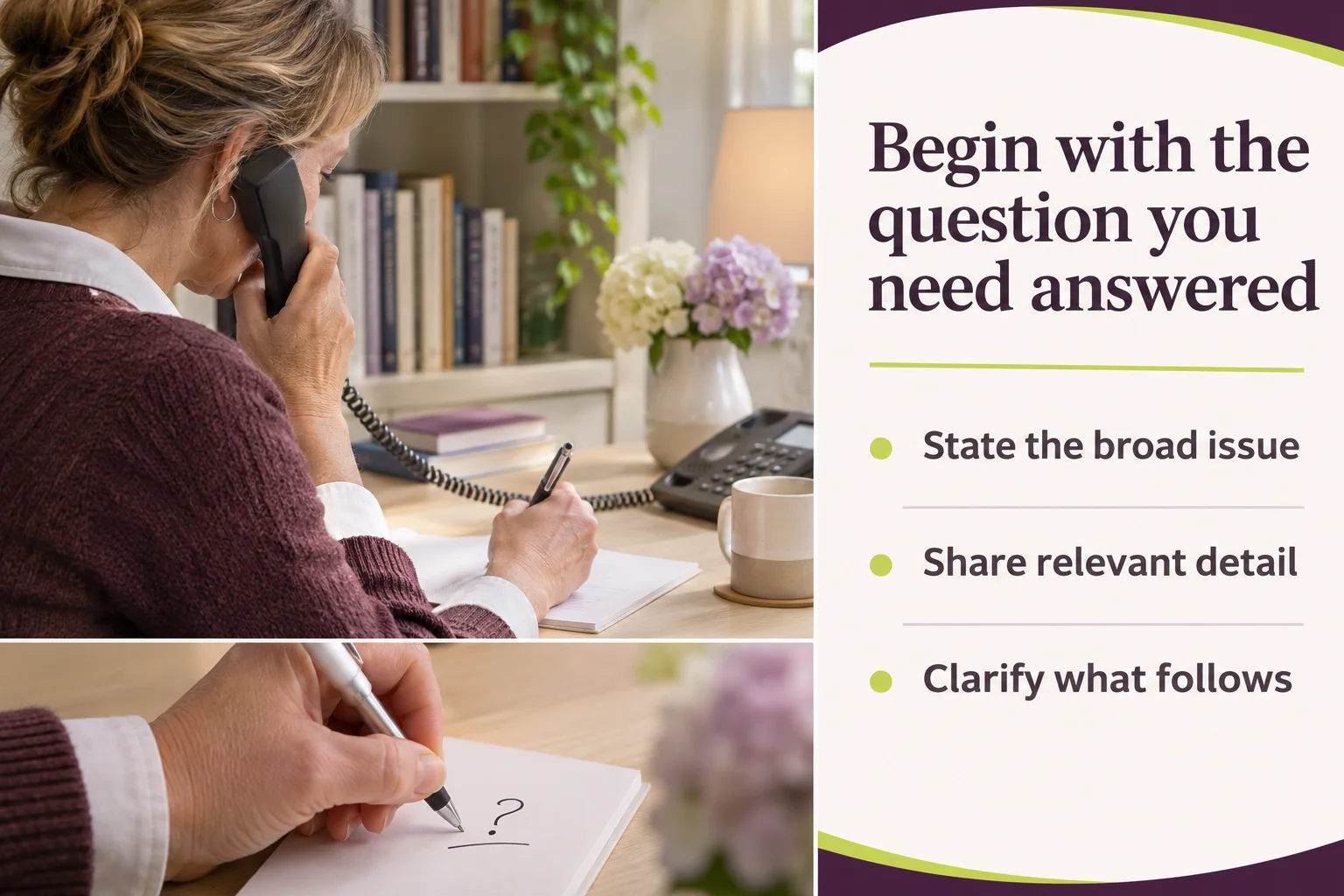
A useful opening can be as simple as explaining that you want to ask about discussing children's arrangements, financial questions after separation or the purpose of an assessment meeting. If your question concerns an appointment already discussed, say that before starting a new explanation. This helps distinguish a general enquiry from a question about a particular arrangement.
| If your call is about | You could begin by |
|---|---|
| An appointment already discussed | Saying so before starting a new explanation |
| A private concern | Explaining that you cannot speak freely, if that is the case |
| Someone else | Explaining that you are calling in that role |
| A concern about the service | Identifying the relevant conversation or arrangement and the point you want addressed |
| A privacy request | Making clear that it is a privacy request |
You do not need polished language. It is reasonable to say that you are unsure which stage to ask about or that you need the difference between an enquiry and a MIAM explained. The important point is what you need to understand. If there are several issues, mention them briefly and identify the one that affects your immediate decision.
Avoid sharing a large amount of sensitive information simply to introduce the topic. Names of children, detailed financial identifiers and private accounts about another person may not be necessary for an initial process question. Ask what information is required and why. A short enquiry can remain useful while keeping disclosure proportionate to its purpose.
03 / Contact Us
Give a privacy concern priority over the background
If you cannot speak freely, begin with that fact. Explain that you need to discuss a private concern before any joint arrangements or contact with another person are considered. You can ask about how a suitability discussion would be handled without giving a detailed history in an unsuitable setting. The place and device you use may matter as much as the words spoken.
Think about who can hear you and whether another person can access your call history or messages. Do not assume that a shared device provides a private channel. If continuing the call becomes difficult, say that you need to stop. A general contact page cannot assess your safety, and a mediation enquiry is not an emergency response.
Where you need an adjustment to communicate, describe the practical assistance you require. Ask what can be considered before relying on a particular arrangement. You do not need to disclose an entire medical history to explain that a slower discussion, a break or a different communication arrangement would help. Availability and suitability still require direct confirmation.
04 / Contact Us
Ask an appointment question in concrete terms
If you are ready to discuss a meeting, ask what type of appointment is being proposed and what it includes. Establish:
- Who would attend
- Whether it is individual or joint
- How it would take place
- What preparation is expected
A title such as consultation does not, on its own, explain the scope of the service or its relationship to later mediation.
Ask about charges before agreeing. Clarify:
- What the amount covers
- Whether it is per person or per stage
- Whether documents or further work may be charged separately
No fee, funding entitlement or free appointment is promised by this website. Cancellation and rescheduling arrangements should also be understood before a commitment is made.
If a date is mentioned, find out whether it is a suggestion or an agreed appointment and how confirmation works. The telephone link itself does not reserve a slot. If the proposed next step is something you want to consider first, explain that. Leaving a conversation with an unanswered question is a reason to seek clarification rather than assume what an arrangement means.
05 / Contact Us
Enquire for someone else without taking over
Friends and relatives sometimes want to understand the process before supporting another person. You can ask general questions and explain that you are calling in that role. This may help you give practical support, such as helping someone prepare a short list of questions or understand why an individual assessment is distinct from a joint meeting.
Calling for another person does not authorise disclosure of their private information, allow you to make decisions for them or entitle you to updates. The person seeking the service may need to speak directly. If they want a supporter involved, that arrangement needs to be discussed clearly rather than inferred from your involvement in the first enquiry.
Do not promise that another family member will participate unless they have actually decided to do so. It is more helpful to describe uncertainty honestly and ask how participation would be considered. The service also needs to assess suitability; the willingness of one person does not settle that question for everyone involved.
06 / Contact Us
Raise a service concern with enough detail to locate it
You can use the same telephone number to ask for clarification or explain a concern about an interaction with the service. Start by identifying the relevant conversation or arrangement and the point you want addressed. Keeping an account factual can make the issue easier to understand. Explain the practical effect and, if possible, the clarification or resolution you are seeking.
Ask which procedure applies to the concern and how it will be handled. This website does not invent a complaints timetable or promise a particular outcome. Where a formal process is relevant, its steps and communication arrangements should be explained directly. Keep your own note of what you have asked and which next action, if any, has been agreed.
A privacy request may require a different assessment from a question about an appointment. Make that distinction explicit. It may be necessary to establish identity before personal information can be discussed. Do not provide passwords or unnecessary identity material during an initial call; ask what is needed and how a suitable verification arrangement will be agreed.
07 / Contact Us
Understand the boundaries of a contact call
An enquiry can explain the process and help identify a possible next step. It cannot guarantee a settlement, confirm the suitability of every case or supply independent legal advice. An initial discussion should not be assumed to produce court documentation or a binding agreement. Ask what a proposed service actually provides before relying on it for a particular purpose.
If you mention a deadline, distinguish the time limit from your preferred timing for a conversation. A mediation service's scheduling arrangements do not alter court rules or an existing order. Where urgent advice or protection is necessary, seek the appropriate assistance separately. The fact that you have asked about mediation does not establish that waiting is suitable.
You can also ask how confidentiality operates before giving sensitive detail. Confidentiality has legal and safeguarding limits and should not be treated as an absolute promise. The handling of information about another person or a child requires particular care. An enquiry does not automatically authorise that information to be circulated or used for unrelated purposes.
08 / Contact Us
Finish with a question you can act upon
Before ending the conversation, check whether there is an agreed action. You might need information about a meeting, time to consider a proposal or clarification from an independent adviser. If an appointment has been arranged, confirm its essential details. If the call was only informational, make sure you have not mistaken that explanation for a booking.
- Check the action. Establish whether there is an agreed action.
- Confirm the details. If an appointment has been arranged, confirm its essential details.
- Note what is uncertain. Write down the precise point that remains unresolved.
Where something remains uncertain, write down the precise point. A note such as check the fee for written work is easier to follow up than a general feeling that the price was unclear. Your own note can support understanding, but it does not replace an appointment confirmation or change the terms you have agreed.
The next step can be modest. Understanding the distinction between assessment and mediation, identifying a privacy concern or finding out what information to prepare may be enough for one enquiry. Call when you can explain your question safely, and keep the purpose of the conversation in view as you decide what to do next.